


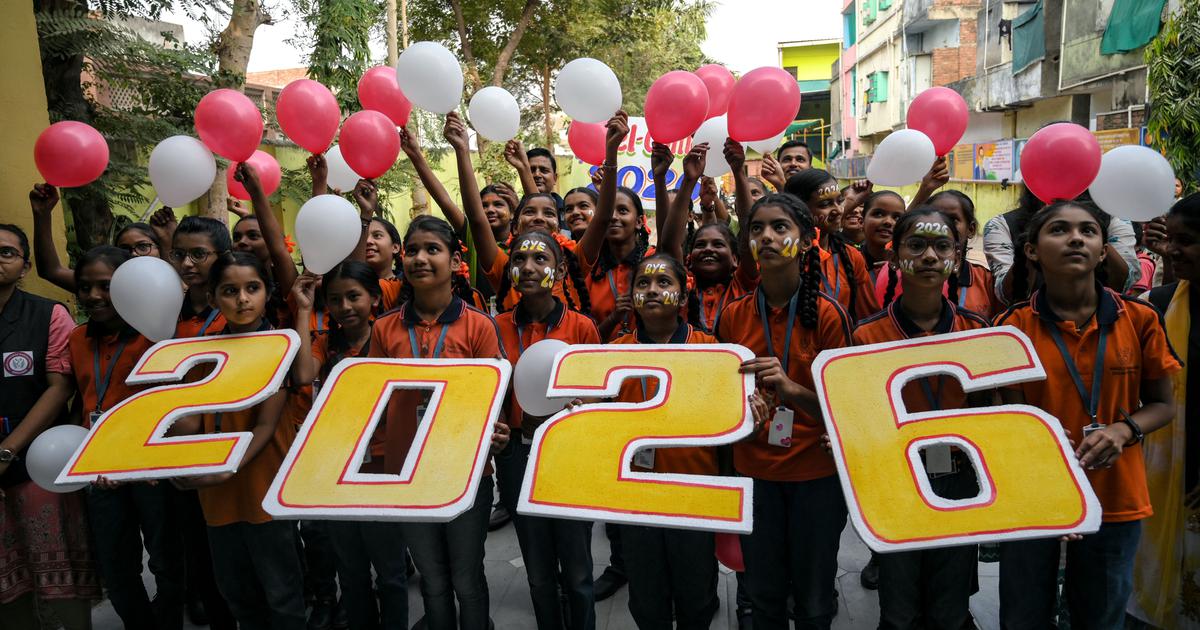
As we enter the second quarter of the 21st century, Scroll editors write about what they are excited about, looking forward to, hoping for or even dreading in 2026.
Naresh Fernandes
In the first half of the year, four states and one Union Territory will vote for new legislative assemblies. The campaigns, as we’ve come to expect, will be corrosive – perhaps even leavened with violence. My hope for 2026 is that voters, no matter what provocations politicians dangle before us, decisively hit the button to recover the promises of the Constitution – especially of fraternity.
Fraternity, after all, as BR Ambedkar noted, “is only another name for democracy”. And democracy, he said, “is essentially an attitude of respect and reverence towards one’s fellow men”. In these times of extreme polarisation, it’s up to us, the people, to reclaim the principles of our Constitution, not just in word but in spirit.
Supriya Sharma
If you live in Delhi, you breathe politics – that’s what I used to hear from journalists based in the national capital, until I became one myself. But it isn’t politics alone that’s been toxic in Delhi over the past decade. I moved to the city around the time its winter air turned unbreathable. What began as a seasonal and regional problem is fast becoming a national crisis, with bad air engulfing even coastal cities. In 2025, for the first time, Delhi residents came out to protest.
In 2026, I look forward to the clean air movement gaining momentum, and more broadly, Indians caring about the slow and steady poisoning of our air, water and land.
Amrita Dutta
All rights and protections in modern nations flow from citizenship. Last year, the Indian state took a hammer to that guarantee as it exists for Indian Muslims, especially Bengalis. Migrant workers from Bengal were summarily thrown out of the country and pushed across the border, or detained and asked to prove they are citizens. That politics trickled down. A spate of lynchings in the last few weeks of the year proved how dangerous it has become to be labelled an “outsider” in India – and fatal to be suspected of being a “Bangladeshi”.
In 2026, I fear the politics of casting out people will continue, and hope that the courts can offer a much-needed check.
Shoaib Daniyal
As incredible as India’s freedom movement was, there is a good argument to be made that the real miracles came after 1947. Unlike almost all other post-colonial countries, India chose to be a democracy. Jawaharlal Nehru’s government made sure universal adult franchise was a cornerstone of the new Union.
Unfortunately, Narendra Modi’s India is now putting this achievement under a cloud. The Election Commission is conducting so-called Special Intensive Revisions in several states. In 2026, West Bengal – the Bharatiya Janata Party’s main target – goes to vote. The SIR has thrown up 32 lakh “unmapped” voters in the state who must prove their eligibility to be included in the rolls. Enough to swing things towards the BJP in certain scenarios.
The right to vote was once guaranteed for Indians. Now not so much. Will 2026 cement this trend?
Aman Khanna
After the sound and fury about India’s economy in 2025, I am hoping for some clarity and transparency in 2026. In another two months, the Union government will announce the new Consumer Price Index series, updating the basket of items used to calculate inflation, and revise the Gross Domestic Product math that earned it a C grade from the International Monetary Fund. Expect many economists to take to newspapers and TV channels, arguing over things like deflators, COICOP and base years.
The debate, even if noisy, will be welcome. At least it will give us some insight into the country’s economic health. If it doesn’t, I know what will be at the top of my wish list in 2027.
Arunava Sinha
Will 2026 usher in a sea-change in publishing in India? Unlikely. The shifts that have already been set into motion will probably continue. Across languages – English isn’t special – publishers will allot money and time to self-improvement guides, with a deepening focus on mind, body and money. This may well mean literary lists being pruned further.
Shallowly researched works of history, spun around figures being planted in the popular imagination, may find even more willing takers. Literary prizes will again flicker briefly, without impacting sales and awareness (since a second successive Booker Prize is very, very unlikely). And while excellent fiction will keep coming from the non-English languages, we’ll have to keep holding our breath for the next outstanding novel in English.
Nandini Ramnath
The year has started on a promising note with Sriram Raghavan’s film Ikkis, which makes a plea for peace and empathy through the portrait of a war hero. However, there will be several films in the coming months that will counter Raghavan’s bold appeal for tolerance.
Muscular filmmaking, characterised by violent spectacle and aggressive emotions are expected to be rolled out. The challenge is to keep calm and carry on, to neither be swayed nor incited by provocations, to always be alive to instances of imagination, honesty and rigour. Among the circuits to watch closely is the international film festival, where Indian independent productions have been turning up with comforting regularity over the past few years.
The Oscars in March will have a host of exciting nominees, such as One Battle After Another, Sinners, Marty Supreme and Hamnet. International films such as No Other Choice, Sentimental Value and The Secret Agent will also be available on streaming platforms in coming weeks.
Divya Aslesha
Joining the chorus of desk editors and journalists at other publications, rather than looking forward, I hope for a return to terrible but very human writing instead of the ubiquitous polished AI babble. As copyeditors, our job is to give shape to the thoughts of writers. But when it comes to text written with AI assistance, it becomes evident that a machine cannot think – it only regurgitates a pattern of writing with vanishingly little logic and coherence.
This year, I hope we relearn the agony of thinking through our thoughts and doing the difficult job of putting them into words.
Nachiket Deuskar
Is Indian foreign policy adrift? We may find answers to this intriguing question in 2026. I am looking forward to watching New Delhi navigate layers of strategic challenges emerging from the mangled rules-based world order.
What will come of the India-United States trade deal and will that help India better deal with Donald Trump? What effects will this have on the “good momentum” in India’s ties with China?
Can tensions with Pakistan – with the hawkish military chief Asim Munir now in absolute control of the country – be managed better? And among other neighbours, can New Delhi succeed in building relations with the new governments in Bangladesh, Nepal and Myanmar?
Here is a summary of last week’s top stories.
A health crisis. At least 10 persons died in Madhya Pradesh’s Indore after consuming contaminated drinking water. More than 1,400 persons had fallen ill with symptoms such as vomiting, diarrhoea and dehydration in the city’s Bhagirathpura area as cases were first reported on December 24. The authorities had earlier said that residents of the area had complained that the water supplied to them had a foul smell.
Residents of the area claim that 14 persons, including an infant, have died.
Congress leader Rahul Gandhi said that Prime Minister Narendra Modi remains silent “every time the poor die”. He alleged that BJP-ruled Madhya Pradesh had become the “epicentre of misgovernance” and asked why the authorities did not pay heed to residents repeatedly complaining about the water.
Protecting the environment. The Supreme Court put on hold its order from November 20 that had accepted a new definition of the Aravalli Hills, citing the need for further clarification. The bench ordered a new committee to be set up to survey and study the hills.
The court had taken suo motu cognisance of the matter amid concerns that the revised definition could enable unregulated mining and environmental damage.
Under the definition accepted in November, an Aravalli hill was described as a landform rising at least 100 metres above the surrounding area, while an Aravalli range was formed by two or more such hills located within 500 metres of each other, including the land between them.
Environmentalists warned that this could leave many ecologically important but lower hills vulnerable to mining and construction.
Crimes against women. The Supreme Court stayed a Delhi High Court order that had suspended the life sentence of former Uttar Pradesh MLA Kuldeep Singh Sengar in the Unnao rape case involving a minor. The court was hearing a petition by the Central Bureau of Investigation challenging the High Court’s December 23 order, which had also granted bail to Sengar.
The bench asked Sengar’s counsel to file a response within four weeks and directed that the complainant be provided legal aid. Despite the High Court’s order, Sengar was to remain in jail as he is also serving a separate 10-year sentence in the custodial death case of the complainant’s father.
The High Court had held that Sengar, as an elected MLA, could not be treated as a “public servant” under the Protection of Children from Sexual Offences Act, a finding contested by the CBI.
Ratna Singh explains why the High Court had released Sengar.
Also on Scroll last week
- This New Year, Scroll staffers wrote about the lingering taste of delectable dishes they enjoy
- How young women in a Jharkhand village became experts in solar technology
- Ancient stones meet modern pollutants: How air pollution is eroding India’s heritage monuments
- Ageing south, populous north and a migration puzzle along India’s fertility faultline
- Harsh Mander: The Constitution’s emancipatory promises on caste remain elusive
- Watch: How the Mahatma Gandhi employment guarantee scheme has been dismantled
- Backstory 2025, where Scroll journalists share their reporting experience
- 2025: A year without alibis
- ‘Ikkis’ review: In tribute to a war hero, a rare plea for peace and empathy
- ‘Krantijyoti Vidyalay Marathi Madhyam’ review: A battle cry to save the Marathi language
Follow the Scroll channel on WhatsApp for a curated selection of the news that matters throughout the day, and a round-up of major developments in India and around the world every evening. What you won’t get: spam.
And, if you haven’t already, sign up for our Daily Brief newsletter.
